
jueves, 4 de junio de 2020

HANDS-ON MATHS: EXPLORING SIMILARITY WITH SHADOWS AND MIRRORS


Compartido por Francisca Arpa:


One of the most effective ways to shape knowledge and cognitive skills is conducting manipulative activities or projects to engage students in the hands-on learning of History.

Option 1: Hands-on Maths

SIMILAR TRIANGLES : EXPLORING SIMILARITY WITH SHADOWS AND MIRRORS

The aim of this Project is  to identify similar triangles, corresponding sides and angles and to apply Thales’s theorem to calcule measurements of distances to inaccesible points .

Thales of Miletus wondered about the height of the  Great Pyramid in  Egypt. Thales notices that the sun’s  shadows  fell from every object in the desert at the same angle, creating similar triangles from every object. Thales’s research allowed him to use similar triangles to measure the height of the pyramids of Egypt and the distance to a ship at sea
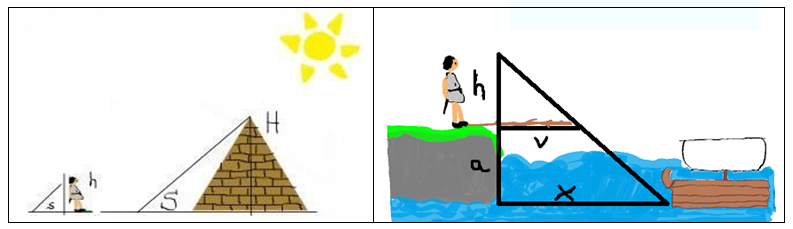


MEASUREMENTS OF DISTANCES TO INACCESSIBLE POINTS

1.- Calculation of the height of the cypress in the schoolyard

We just need measuring tape, paper, pen and a sunny day

The students will be divided into groups of four, one of them will be the benchmark for the measurement, the other two will measure the height of the student and the respective measurements of the shadows of the tree and the student, the fourth member of the group will write down measures.

Then using Thales they will calculate the height of the cypress


The groups will present the measurement obtained and check if they have reached a similar result

2.- Working with a mirror


A mirror placed on the floor can also be used to determinate measures indirectly. When teh mirror is placed at a particular distance from the wall, the distance that and observer stands from the mirror determines the reflection that the observer sees in the mirror.


In groups of four students, they will perform the following steps
*     Find a spot on the floor 8 m away from one of the walls of your classroom.
*     Place a mirror on the floor, 2m from that wall
*     Each gropu member should take a turn standing on the spot 10m from the wall and look into the mirror. Other group member should help the observer  locate the point on the Wall that the observer sees in the mirror and the measure the height of this point above the floor.
*     Before moving the mirror, each group member should take a turn as the observer.
*     Repeat the same process by moving the mirror to locations that are 3 m and 4m away from the Wall

I.-The students can use this table to record results:

Distance from the Wall to the mirror (in m)
Height of the Point on the Wall reflected in the mirror ( in m)

Person A
Person B
Person C
Person D
2


3


4


b) Measure the eye-level height for each member of the group and record it in the table :

eye-level height for each group member
Person A
Person B
Person C
Person D


c) - Consider the data collected when the mirror was 2m from the wall
     On the diagram below, label the height of each  group member and the height of the point on th e wall determined by the group member


d)- For each person in the group, determine the ratio of the height of the point on the wall to the eye-level height of the observer

Ratio  of height of the point on the wall  tp eye-level of observer

Person A
Person B
Person C
Person D
Ratio as a fraction


Ratio as a decimal


e).- Repeat when the mirror was 3 from the wall and  when the mirror was 4m from the wall
 f).- Express regularity in repeated reasoning. What appears to be true about the ratios you found?

     Finally you can propose to the whole class that they discuss how they would use the mirror method to calculate the height of their classroom


miércoles, 3 de junio de 2020

Shared by Francisca Arpa

This project is intended to be carried out jointly with the teacher of the bilingual section of physical education.


Olympic Measures

This problem invites students to engage with units of measurement and orders of magnitude, by presenting a variety of records and measurements from events at the Olympic Games. 

Some will be familiar to students, others may lend themselves to estimation or a little research.  Hand out this set of cards and invite students to work in pairs together:

Below are some interesting measurements and records from events at the Olympic Games. Unfortunately they have been muddled up. Can you cut out the cards and regroup them correctly?


If students are stuck, here are some key questions to help them:

Which quantities are likely to be whole numbers? Why?

Which quantities are lengths? Which are times? Which are speeds? Which are masses?

Which units might belong with the lengths... times... speeds... masses...?

Can you rank the different lengths... times... speeds... masses in order of magnitude?


Finish by bringing the whole class together to agree on a class ordering for the cards. Students will need to convince each other of their own ordering by explaining what they are certain of, and justifying their educated guesses.

The videos of impressive world record performances available on  https://listverse.com/2007/10/02/top-10-impressive-athletics-world-records/ might be of interest to students.


Invite students to do some research to create a set of similar cards of their own to swap with a friend.

To carry out this joint project, the following steps will be followed:
             - In physical education class a session will be dedicated to talk about the different Olympic sports and it will be proposed that in groups of four they make a power point about three Olympic sports, indicating the records achieved, they will have a period of 15 days to do it.
             - Once this activity is carried out in PE, the activity designed with the cards will be carried out in math class, it will be carried out in two or three sessions.
          - After completing the activity of the math class. In PE class students will watch the videos of impressive world record performances available on: 

INTRODUCING THE METRIC SYSTEM


Comparido por Marta Álvarez


I use this video to introduce the unit about the metric system:¡


Why the metric system matters - Matt Anticole


To refresh their previous knowledge and make them talk, I start by asking them what units do they know, and when they answer I ask what magnitude are they measuring with them. Then I ask what length units they can remember. I write them on the blackboard and ask for an example of what would they measure with those. We get a wide vocabulary we are going to use later. I also ask if they have heard about other units, like miles, yards or foot. Some of them usualy do.

Then we watch the video. History, Geography and Maths, I think it is interesting.

When it ends I ask for things they haven't understood. They have to ask using complete sentences. I keep a dictionary (Wordreference) open on the whiteboard and we look for words, checking the pronunciation. After those questions, they work in small groups with a worksheet I give to them. I got the questions from:
https://ed.ted.com/lessons/why-the-metric-system-matters-matt-anticole#review

These are the questions:

Who was the earliest advocate for a uniform measuring system?
a. Marquis de Concordet
b. Napoleon Bonaparte
c. John Wilkins
d. Ernest Rutherford

What historical event was pivotal in the adoption of a unified measurement system?
a. The 1918 Flu Epidemic
b. The French Revolution
c. The 1846 Potato Famine
d. World War I

What defines our current ‘standard’ for one meter?
a. The length of a pendulum arm that takes 1 second to swing from left to right
b. The distance equal to 1/10,000,000 the distance between the Equator and North Pole
c. The distance light travels in a tiny fraction of a second
d. The distance a 1 kilogram object travels in one second when acted on by a force of 1 newton

The word meter derives from a Greek word that means:
a. Global
b. Stride
c. Hearth
d. Measure

What might common French citizens have liked about the metric system when it was adopted? What might they have disliked? Why?

What circumstances during the French Revolution permitted the metric system to gain a foothold?

Which of the following is NOT an advantage of the metric system?
a. It helps to streamline trade between different countries
b. It has been officially adopted by every country around the globe
c. It provides a common language to discuss scientific data
d. It is based on measurements from the world itself and not arbitrary standards


Then we correct the activity in plenary making sure every member of the group speaks.


Compartido por Francisca Arpa


IRRATIONAL NUMBERS      3º ESO

To introduce  irrational numbers I’ll begin with this video


After watching the video  I’ll ask them some questions about it


        In pairs, students will classify numbers as rational or irrational fminutes using this                 worksheet as example.


Each student will choose a number and ask the other student if the number is rational or irrational, the answer must be similar to the example.
At the end  of the activity they must elaborate their own  worksheet with the numbers they have chosen


Group work

This activity is meant to reinforce definitions and fluency in describing irrational numbers and rational numbers.

 The class will be organize in groups of 4 students and  one by one, each student in the group is going to take one of  these  cards  and  talk about the  chosen card:

Tell what an irrational number is in your own words.

Provide two examples that show that the statement is false. Lydia said that all square roots are irrational numbers.

Do the expressions    and    have the same value? Explain your thinking.

Provide two examples that show that the statement is false. Explain your thinking.
Zoe said that an irrational number can be expressed as a terminating decimal.


PROJECT

Students, in groups of 4 people, will chose one of the famous irrational number : π (pi), e ( Euler’s number) , φ ( golden ratio). They will have a week to look for information about it and make a presentation or a poster. In plenary, they will show their presentation or poster

Driving Questions about big data in apps


Compartido por Ana Espeja:

Who?  What?  Where?  When?  Why?  &  How?
Write down 5 driving questions that can be used in your class

I would like to make a set of 5 different questions related to maths and big data, since I think it is a highly topical question. Furthermore, as I see it, students may be interested in this issue.


1.    According to the chart.
How did Facebook income change from 2010 to 2015?

2.    What is the relationship between the number of users and the Company earnings? Is it linear? Or is it an exponential growth?

3.    Why do you think many companies give loyalty cards to their customers?
What can they do with the information they record about what we buy?

4.    According to the chart.
How did Facebook income change from 2010 to 2015?

5.    What is the relationship between the number of users and the Company earnings? Is it linear? Or is it an exponential growth?

6.    Why do you think many companies give loyalty cards to their customers?
What can they do with the information they record about what we buy?

Pythagoras – Father of Harmonics

Eva de Prado shares: Pythagoras – Father of Harmonics Pythagoras discovered the musical intervals. He also lectured people in the ...